

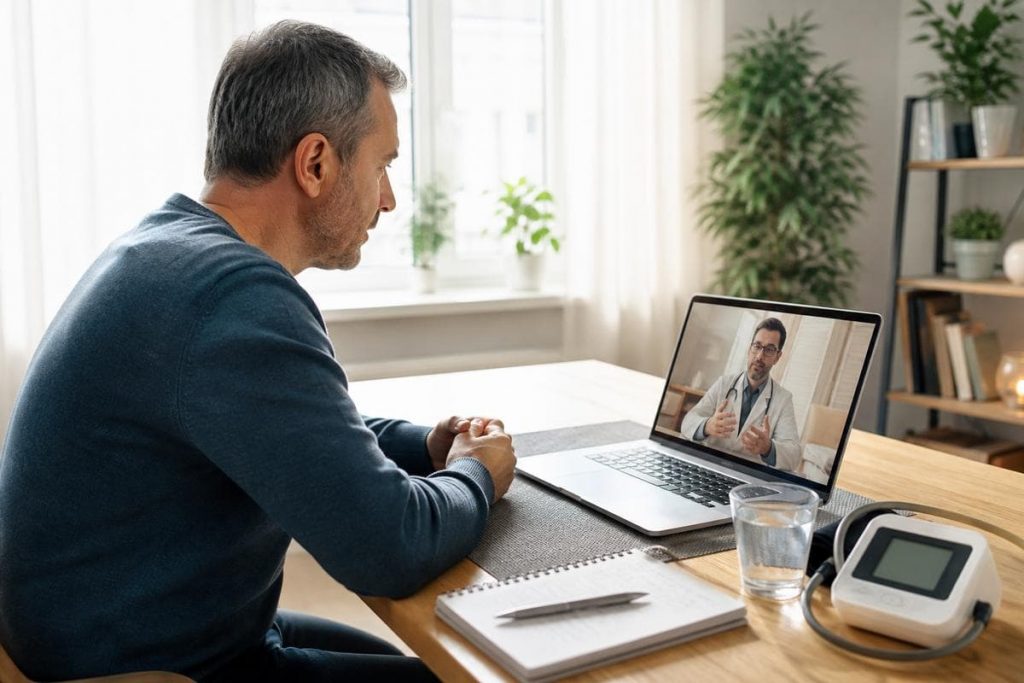
Over the past few years, telemedicine has stopped being a backup option for patients who are busy or live far from medical facilities. Telemedicine in 2026 has become part of routine clinical practice: it saves time, simplifies monitoring, and helps patients obtain medical advice more quickly, but it does not replace every form of healthcare. This article will help you understand when you can be treated remotely and when an in-person appointment is the safer and more accurate choice.
What Telemedicine Is and How It Works in 2026
To briefly answer the question of what telemedicine is, it is a form of healthcare delivery using secure digital communication channels. Modern telemedicine in 2026 includes not only video consultations but also integration with electronic medical records, laboratory systems, and data from home blood pressure monitors, glucose meters, and wearable devices. In real-world practice, telemedicine in 2026 is not simply messaging with a doctor but a full consultation with access to medical records, test results, and the ability to issue prescriptions remotely, where permitted by the regulations of the specific country, clinic, and clinical situation.
During an online appointment, the doctor reviews the patient’s complaints and medical history, evaluates changes in symptoms, examines test results, and compares them with an already established diagnosis. For many conditions, this is sufficient to adjust treatment, explain the monitoring strategy, or determine whether an in-person examination is necessary. At the same time, the quality of such a consultation depends not only on the specialist’s qualifications but also on the completeness of the available information: up-to-date test results, a list of medications, information about allergies, coexisting conditions, and previous medical procedures.
When Telemedicine Can Fully Replace an In-Person Appointment
Remote care is particularly useful when the doctor’s primary task is to assess changes in an already known condition and make a decision based on medical records, symptoms, and previous prescriptions. In these cases, chronic diseases in remission, scheduled consultations to discuss test results, and continuation of previously prescribed treatment are optimal scenarios for remote appointments, because diagnostic uncertainty is relatively low and the risk of missing an acute condition is lower.
- adjusting medication doses for a stable chronic condition
- interpreting laboratory tests and examination results
- consultations on nutrition lifestyle and prevention
- psychotherapy sessions and psychiatric follow-up for stable conditions
- follow-up consultations when a diagnosis has already been established
In these scenarios, the answer to the question of when you can be treated remotely is most often positive. The situations in which an online doctor consultation is most appropriate include follow-up after an in-person examination, monitoring of hypertension, diabetes mellitus, hypothyroidism, or bronchial asthma outside of exacerbations, as well as discussing treatment side effects when the patient’s condition remains stable. The remote format is also convenient for interpreting test results: the doctor does not simply “read the numbers” but evaluates them in the context of age, symptoms, coexisting conditions, and previously prescribed treatment.
What a Doctor Cannot Do Remotely
Despite technological advances, the limitations of telemedicine remain significant. Even high-quality video communication cannot replace examining the skin in cases of a complex rash, palpating the abdomen, assessing edema, performing a complete neurological examination, or measuring blood oxygen saturation with professional equipment. In clinical practice, physical examination, palpation, auscultation, and instrumental examinations cannot be performed online — yet they often provide crucial diagnostic information without which dangerous conditions cannot be reliably ruled out.
Therefore, a doctor cannot always make an initial diagnosis based solely on a description of symptoms. What cannot be done during an online medical consultation includes listening to the lungs and heart with a stethoscope, performing an ECG, ultrasound, X-ray, endoscopy, a complete neurological examination with reflex testing, surgical wound care, injections, dressings, or collecting samples for laboratory testing. In addition, it is more difficult to assess dehydration, the severity of respiratory failure, signs of peritoneal irritation, and acute vascular or traumatic conditions remotely. This is why telemedicine is effective as part of a patient’s healthcare pathway but not as a universal replacement for all in-person medical care.
Which Symptoms Should Not Be Managed With Telemedicine Alone
There are situations in which relying on remote care can be dangerous because valuable time may be lost before in-person diagnosis and treatment begin. For certain symptoms, a simple rule applies: if a symptom may indicate a heart attack, stroke, bleeding, an acute abdominal condition, severe infection, or respiratory failure, online advice should not be the only action taken. In these cases, chest pain, shortness of breath, acute abdominal pain, neurological symptoms, and any sudden deterioration in well-being require an in-person examination or emergency medical assistance, because the outcome may depend on the first few hours.
- chest pain especially if it radiates to the arm or jaw
- sudden severe headache speech impairment or vision problems
- acute abdominal pain with nausea and fever
- shortness of breath at rest and rapid heartbeat
- high fever in children under three years of age and elderly people
Symptoms requiring an in-person medical assessment also include loss of consciousness, seizures, severe weakness in the limbs, blood in vomit or stool, severe dehydration, rapidly increasing swelling, head injury, suspected fracture, a sudden drop in oxygen saturation, and any signs of sepsis. When deciding when online treatment is not appropriate, it is important to consider not only the intensity of pain but also how quickly it develops, the presence of several warning signs, and risk factors such as older age, pregnancy, cancer, immunodeficiency, and severe heart or lung disease.
How to Choose a Platform for an Online Consultation
The quality of a remote consultation depends largely not on the service’s interface but on the transparency of its medical operations. Before booking an appointment, it is important to check who will conduct the consultation, whether the service is licensed, how data is stored, whether test results can be uploaded, and whether a consultation report is provided. For a patient deciding how to choose a telemedicine service, it is essential to understand that a reliable telemedicine platform works with licensed doctors, uses a secure data transmission channel, and provides access to the patient’s medical documentation, rather than being limited to a chat service without clinical responsibility.
A good platform for online doctor consultations allows patients to verify the specialist’s identity, view their specialty and experience, attach documents, receive written recommendations, and, when necessary, obtain a referral for an in-person examination. It is also useful if the system supports laboratory integration, follow-up appointment reminders, and secure payment. Particular attention should be paid to confidentiality: medical data is sensitive information, so encryption, data retention policies, and consent to personal data processing are not mere formalities but an important part of treatment safety.
The Future of Telemedicine and Its Limitations
Digital healthcare is developing toward more accurate remote monitoring. The future of telemedicine is already closely connected with the analysis of data from wearable devices and home monitoring of blood pressure, glucose, heart rate, oxygen saturation, and sleep. In this model, artificial intelligence, remote health monitoring, and wearable devices expand the possibilities of remote medicine but do not eliminate the need for direct contact with a doctor, because algorithms can help assess risks and monitor changes over time but cannot replace clinical reasoning, physical examination, and a healthcare professional’s responsibility.
The development of telemedicine in 2026 makes healthcare more accessible to people living in small towns, patients with limited mobility, and those who require frequent monitoring. However, the method still has limitations: incomplete data, technical failures, the risk of underestimating the severity of a condition, and the inability to perform an immediate examination. The most reliable approach combines remote and in-person care in accordance with clinical guidelines, evidence-based medicine, and the actual purpose of each consultation. Therefore, telemedicine in 2026 is an effective tool for patient routing, monitoring, and treatment support, but the question of when you can be treated remotely should always be decided based on symptoms, diagnosis, and the likelihood that an in-person appointment may still be necessary.